Introduction
When OpenAI CEO Sam Altman publicly admitted in August 2025 that “investors as a whole are overexcited about AI”, his words sent ripples through Wall Street and beyond. As the architect of the AI revolution that began with ChatGPT, Altman’s candid warning wasn’t mere speculation—it was a seasoned insider’s honest assessment of a market spiraling toward dangerous territory.
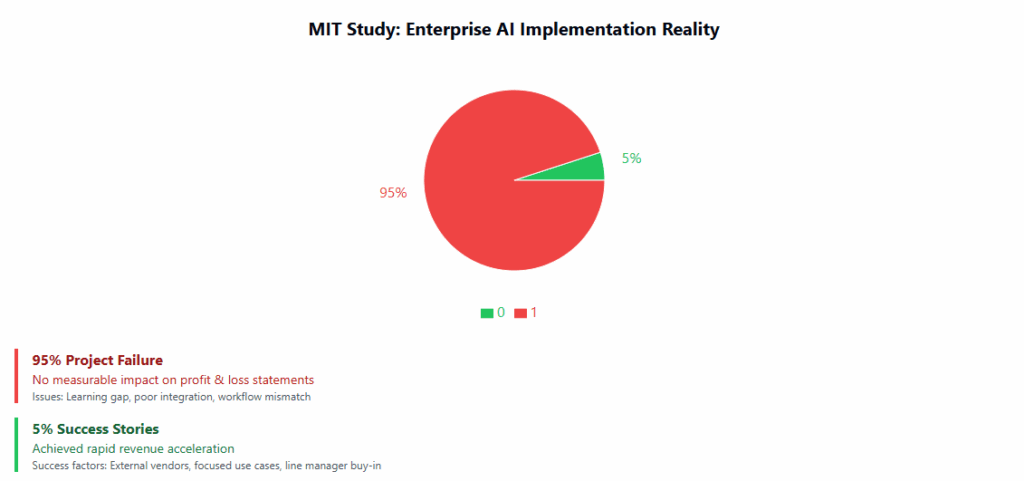
The numbers tell a stark story: AI-related stocks have surged over 250% since September 2022, driving the majority of S&P 500 gains. Yet beneath the surface lies a troubling reality: MIT’s latest research reveals that 95% of enterprise generative AI pilot programs are failing to generate measurable financial impact.

Chapter 1: Altman’s Bubble Warning – Confessions of an AI Kingmaker
1.1 The “B-Word” Heard Around Wall Street
At a private dinner with reporters in August 2025, Sam Altman repeated the word “bubble” three times in 15 seconds, then half-joked: “I’m sure someone’s gonna write some sensational headline about that. I wish you wouldn’t, but that’s fine.”
His core message was both reassuring and alarming:
“When bubbles happen, smart people get overexcited about a kernel of truth. Are we in a phase where investors as a whole are overexcited about AI? My opinion is yes. Is AI the most important thing to happen in a very long time? My opinion is also yes.”
This paradoxical stance—acknowledging both revolutionary potential and speculative excess—captures the complexity facing today’s investors.
1.2 The Dot-Com Déjà Vu
Altman compared current market conditions to the infamous dot-com bubble of the late 1990s, when the Nasdaq lost nearly 80% of its value between March 2000 and October 2002 as internet companies failed to generate revenue or profits.
But as Altman noted, the parallel offers hope: Amazon survived the dot-com crash to become one of the world’s most valuable companies. The question for today’s AI investors is which companies will follow Amazon’s path and which will join the digital graveyard.
1.3 The OpenAI Paradox
While warning of bubble dynamics, OpenAI itself embodies the contradiction. The company secured $8.3 billion in new funding at a $300 billion valuation in early August 2025, with plans to raise $40 billion total this year. Simultaneously, Altman declared OpenAI would “spend trillions of dollars on data center construction in the not very distant future”.
This disconnect between cautionary words and aggressive spending reveals the high-stakes bet underlying the entire AI economy.

Chapter 2: The Trillion-Dollar Infrastructure Gamble
2.1 Unprecedented Capital Deployment
The scale of AI investment has reached astronomical proportions. McKinsey projects that companies worldwide will need to invest $5.2 trillion into new data center capacity by 2030 to meet AI demand.
The Hyperscaler Spending Spree
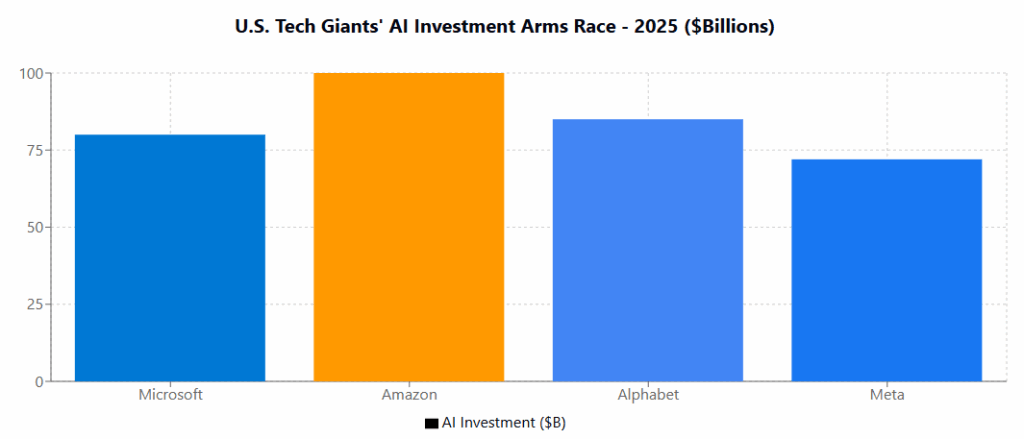
Tech’s biggest names have all raised capital expenditure guidance: Microsoft targeting $80 billion in AI data centers, Amazon topping $100 billion, Alphabet at $85 billion, and Meta lifting capex to $72 billion.
GDP-Level Impact
Perhaps most remarkably, AI data center spending has contributed more to U.S. GDP growth than consumer spending in the first half of 2025—the first time this has occurred in American economic history.
2.2 The Valuation Extremes
Apollo Global Management’s chief economist Torsten Slok argues that the current AI boom may surpass the internet bubble of the 1990s, with the top 10 companies in the S&P 500 more overvalued relative to fundamentals than during the peak of the dotcom era.
Nvidia’s Nosebleed Territory
The AI chip leader’s valuation metrics have reached historic extremes, with price-to-sales ratios exceeding those of Amazon and Cisco at their pre-crash peaks.
2.3 The Warning Signs Mount
Data center investments’ contribution to GDP growth has equaled consumer spending over the first half of 2025, notable since consumer spending typically comprises 70% of GDP. This unprecedented shift signals the extent to which the U.S. economy now depends on AI investment momentum.

Chapter 3: The DeepSeek Shock – China’s “Sputnik Moment”
3.1 The $5.6 Million Miracle
In January 2025, Chinese startup DeepSeek delivered what Marc Andreessen called “one of the most amazing and impressive breakthroughs I’ve ever seen”: a reasoning AI model that rivals OpenAI’s capabilities, built for just $5.6 million using knowledge distillation techniques.
3.2 Market Carnage
The implications were immediate and devastating for Western tech stocks:
- Nvidia fell nearly 17% and lost $588.8 billion in market value—the largest single-day loss in stock market history
- The Philadelphia Semiconductor Index tumbled 9.2%—its largest drop since March 2020
- The tech-heavy Nasdaq plunged 3.1% while the broader S&P 500 fell 1.5%
3.3 The Knowledge Distillation Revolution
DeepSeek’s breakthrough relied on knowledge distillation—a technique where a smaller “student” model learns from a larger “teacher” model. Berkeley researchers recreated OpenAI’s reasoning model for $450 in 19 hours using similar techniques, while Stanford and University of Washington researchers created their own reasoning model in just 26 minutes using less than $50 in compute credits.
The Geopolitical Implications
DeepSeek’s success came despite U.S. restrictions designed to limit China’s access to advanced AI chips, raising questions about the effectiveness of export controls. The company achieved its breakthrough using older H800 chips rather than cutting-edge hardware.
3.4 Threat to U.S. Tech Dominance
“DeepSeek shows that it is possible to develop powerful AI models that cost less,” said Vey-Sern Ling at Union Bancaire Privee. “It can potentially derail the investment case for the entire AI supply chain, which is driven by high spending from a small handful of hyperscalers.”
President Trump called DeepSeek’s emergence a “wake-up call” for U.S. industries to stay “laser-focused on competing to win”.

Chapter 4: The MIT Reality Check – 95% Failure Rate
4.1 The Inconvenient Truth
MIT’s NANDA initiative published “The GenAI Divide: State of AI in Business 2025,” revealing that despite $30-40 billion in enterprise investment, 95% of generative AI projects yield no measurable business return.
The study, based on 150 interviews with business leaders, 350 employee surveys, and analysis of 300 public AI deployments, paints a sobering picture of AI’s commercial reality.
4.2 The Integration Gap
The core issue isn’t AI model quality but the “learning gap” between tools and organizations. Generic tools like ChatGPT excel for individuals but fail to adapt to enterprise workflows.
Success vs. Failure Patterns
- Purchased solutions: 67% success rate
- Internal development: 33% success rate
- Budget misallocation: Over half of AI budgets target sales and marketing, while strongest returns come from back-office automation
4.3 The Wall Street Reaction
The MIT study sparked a tech selloff, with Nvidia dropping 3.5% and Palantir sliding nearly 10%. The market reaction highlighted growing concerns about AI’s commercial viability.

Chapter 5: Investment Strategy for Western Markets
5.1 The New Reality Check
The combination of Altman’s warnings, DeepSeek’s disruption, and MIT’s failure statistics forces a fundamental reassessment of AI investment strategies.
Key Risk Indicators
- Valuation Extremes: The S&P 500’s top 10 companies trade at 29x forward earnings vs. 19x for the rest of the index
- Market Concentration: The Magnificent Seven now comprise nearly 35% of S&P 500 market cap
- Reality Gap: Enterprise adoption failing despite massive infrastructure spending
5.2 Portfolio Recommendations for Western Investors
Infrastructure Over Speculation
Focus on companies providing essential AI tools rather than speculative “moonshot” startups. Allocate larger portions to undervalued infrastructure giants like Alphabet (forward P/E of 25, below S&P 500 average) that offer stability and long-term growth.
Geographic Diversification
“DeepSeek’s rise could spark renewed investor interest in undervalued Chinese AI companies, providing an alternative growth story,” notes Charu Chanana at Saxo.
Defensive Positioning
- Energy Sector Caution: Energy companies plummeted on DeepSeek news, with Constellation Energy falling 21% and Vistra down 28%
- Semiconductor Selectivity: Avoid overvalued chip stocks while identifying survivors
5.3 Time Horizon Strategies
Short-Term (6-12 months)
- Reduce AI overweights: Particularly stocks trading above 30x P/E
- Build defensive positions: Utilities, consumer staples, dividend aristocrats
- Maintain dry powder: 15-20% cash for post-correction opportunities
Medium-Term (1-3 years)
- AI Value Chain Analysis: From hardware and hyperscalers to developers and integrators, with focus on companies showing actual revenue acceleration
- European AI Champions: Companies like Mistral AI benefiting from efficiency trends
- Knowledge Distillation Winners: Firms mastering cost-effective AI development
Long-Term (3-10 years)
- Fundamental Survivors: Companies with genuine AI integration and measurable ROI
- Infrastructure Plays: Data centers, networking, security solutions
- Human-AI Collaboration: Tools that augment rather than replace human capabilities

Chapter 6: The Path Forward – Navigating Post-Bubble Opportunities
6.1 The Historical Precedent
As Altman noted, “The dot-com bust didn’t kill the internet as we know it, and many of the ideas pioneered during that era, such as e-commerce and search, engendered trillion-dollar companies”.
The question for investors isn’t whether AI will survive—it will. The question is identifying which companies will emerge stronger from the inevitable correction.
6.2 The European Perspective
European startups have hailed DeepSeek as proving the viability of mini-language models, offering EU companies a chance to compete despite disadvantages like limited capital and compute access.
For European investors, this represents both threat and opportunity—Chinese efficiency techniques may level the playing field while reducing dependence on U.S. tech giants.
6.3 The Regulatory Response
European regulators worry that DeepSeek’s success could create a “race to the bottom” by incentivizing companies to cut safety and security guardrails to release similar models faster.
The EU AI Act, taking effect in August 2025, will significantly impact how AI models are developed and deployed in European markets.

Conclusion: Smart Money in Uncertain Times
As the AI revolution enters its most volatile phase, Western investors face unprecedented challenges and opportunities. The convergence of insider warnings, competitive disruption, and implementation failures signals a market reckoning that’s long overdue.
Key Takeaways:
- Don’t ignore the warnings: When industry leaders like Altman admit to bubble conditions, prudent investors take notice
- Embrace the disruption: DeepSeek’s knowledge distillation breakthrough changes everything—adapt or be left behind
- Focus on fundamentals: The 95% failure rate in enterprise AI deployment separates hype from value
- Think globally: Chinese AI advances represent both competitive threat and investment opportunity
The AI revolution will continue, but the easy money phase is ending. Success will require careful analysis, disciplined allocation, and the wisdom to distinguish between transformative technology and speculative excess.
As we navigate this inflection point, remember Altman’s duality: AI truly is “the most important thing to happen in a very long time,” but that doesn’t mean every AI investment will succeed. In a world of trillion-dollar experiments and $5.6 million breakthroughs, smart money follows evidence, not enthusiasm.
The bubble may be real, but so is the opportunity—for those prepared to navigate both with equal skill.
This analysis is based on August 2025 market data and research reports. All investments carry risk, and past performance doesn’t guarantee future results.

Sources and References
- Sam Altman Bubble Warning – The Verge, CNBC, Fortune (August 2025)
- McKinsey Data Center Investment Projections – McKinsey & Company (2025)
- MIT NANDA Enterprise AI Failure Study – MIT NANDA Initiative (August 2025)
- DeepSeek Market Impact Analysis – Bloomberg, CNBC, CNN Business (January 2025)
- Knowledge Distillation Research – Berkeley, Stanford, UW (2025)
- European AI Market Analysis – Bruegel, CSIS (2025)
- U.S. Tech Dominance Assessment – Foreign Policy, Project Syndicate (2025)
Tags: #AIBubble #DeepSeek #SamAltman #TechInvesting #KnowledgeDistillation #NvidiaStock #AIValuation #InvestmentStrategy #TechBubble #ArtificialIntelligence