Introduction: Entrepreneurship Is No Longer Just for the Wealthy
In this era of digital transformation, the barriers to entrepreneurship are rapidly diminishing. Have you ever abandoned your startup dreams due to lack of substantial funding? Or worried about investing significant resources only to find your product doesn’t gain market acceptance? If these concerns have troubled you, then the “lean tech entrepreneurship model” will open a door to entirely new possibilities.
The landscape has fundamentally changed. 75% of SaaS startups that hit $1M ARR in 2024 were bootstrapped or indie-built, proving that success doesn’t require massive initial investment—it requires smart strategy and execution.

What Is Lean Tech Entrepreneurship?
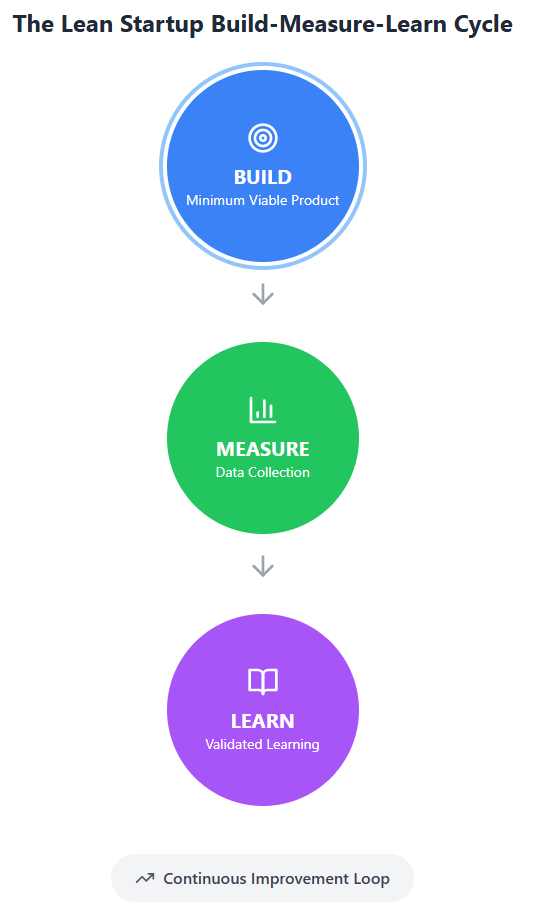
Lean Startup is a methodology for developing businesses and products first introduced by Eric Ries in 2011. The core philosophy centers on launching a minimal prototype in the market, then continuously learning from valuable user feedback to rapidly iterate and optimize the product for market fit.
Bootstrapping refers to building a business from the ground up without external capital investment. This typically means using your savings, funds from friends or family, or revenue from initial sales to build and grow your enterprise.
The combination of these approaches has proven incredibly effective. According to SaaS Capital’s recent benchmarks, bootstrapped SaaS companies report a median annual growth rate of 23%, while venture-backed counterparts see a slightly higher median of 25%—a remarkably small gap that demonstrates the viability of self-funded growth.

Three Core Strategies: Making Your Startup Journey Smarter
1. Minimum Viable Product (MVP): The Power of Smart Iteration
Remember how Dropbox began? Drew Houston, the co-founder, created a simple video that showed how the service would work and shared it with a few friends. The success of this MVP was evident in the over 70,000 signups generated from a single demonstration video. This exemplifies MVP’s true power—validating maximum market demand with minimum resources.
An MVP isn’t a rough product; it’s a precision experimental tool that answers the most critical question: “Does my product solve a real problem?”
2. Rapid Iteration: Finding Opportunities in Change
In our rapidly evolving environment, “perfect” business plans are time-wasters. We should start driving and adjust direction at each intersection. This mindset completely overturns traditional product development models.
Rapid iteration encompasses more than technical updates—it’s an agile business philosophy that enables you to:
- Quickly respond to market changes
- Reduce decision-making risks
- Improve resource utilization efficiency
- Build competitive advantages
3. Customer Feedback Loops: Let the Market Be Your Teacher
Recognizing market needs to create appropriate products and services is lean startup’s core objective. Establishing effective customer feedback loops helps you avoid the tragedy of “climbing the wrong mountain”—spending enormous effort only to discover you’ve built something the market doesn’t need.

SaaS: The Perfect Low-Cost Startup Model
In the Software as a Service (SaaS) sector, low-cost startup models are particularly favored. Companies like Zoho, Mailchimp, Zapier, and Basecamp all successfully built enterprises through bootstrapping and now thrive in the marketplace.
The numbers support this trend. Global end-user spending on SaaS is estimated to hit $247.2 billion in 2024, showing a 20% year-over-year increase. Worldwide SaaS spending is forecasted to grow to $295.08 billion in 2025.
Why Is SaaS Particularly Suitable for Low-Cost Startups?
- Lower initial investment: No need for physical equipment or inventory
- Scalable business model: Once established, marginal costs approach zero
- Subscription revenue model: Provides stable cash flow
- Global market access: Internet connectivity reaches customers worldwide

Practical Guide: How to Start Your Lean Tech Startup
Step 1: Financial Management Strategy
Prioritize revenue-generating activities, maintain low operational costs, carefully manage accounts receivable, and reinvest profits in areas with the highest return on investment.
Specifically:
- Bootstrap mindset: Do the most with the least money
- Cash flow is king: Ensure positive cash flow every month
- Precise investment: Only invest in projects directly impacting revenue
Step 2: Leverage External Resources
Outsourcing can serve as a strategic tool for business expansion without building large internal teams. Many platforms and tools now help reduce costs:
- Talent platforms: Use Upwork, Toptal, and similar platforms to find professionals
- Free tools: Utilize open-source software and free cloud services
- Automation tools: Reduce repetitive work and improve efficiency
Step 3: Build a Learning Organization
Lean startup methodology integrates “experimental validation of business hypotheses,” “rapid product updates and iterations,” and “validated learning” through minimal viable products to shorten product development cycles.

Avoiding Common Pitfalls: Three Myths Every Entrepreneur Must Know
Myth 1: Products Must Be Perfect Before Launch
Lean startup’s core principle is dramatically shortening product modification and update cycles. Perfect is the enemy of progress—launch an 80% complete product first, then continuously improve based on user feedback.
Myth 2: Large Capital Is Required to Start
Many successful tech companies started in garages or dorm rooms. Growing from $3M to $20M as a bootstrapped business is where real leverage begins to show. This is the stage when owners can start building meaningful enterprise value without giving up control.
Myth 3: Revolutionary Innovation Is Mandatory
Flickr originally started as an online gaming website before pivoting to become a globally recognized photo-sharing platform. Sometimes success comes from better satisfying existing needs rather than complete innovation.

2025 Opportunities and Challenges
Emerging Opportunities
AI-Assisted Development: The integration of artificial intelligence in product development is accelerating innovation while reducing costs.
No-Code/Low-Code Platforms: The MVP approach is highly versatile, making it suitable for a wide range of industries and use cases. Here are a few examples: AI-Powered Tools: Quick launches of AI-driven apps to capitalize on emerging trends. SaaS Platforms: Simplified versions of software products to test market demand.
Remote Work Trends: Reduced office costs and access to global talent pools.
Vertical SaaS Markets: Focusing on specific industry needs rather than horizontal solutions.
Niche Market Development: Concentrating on deep, specific needs while avoiding competition from large companies.
Potential Challenges
Market Competition Intensification: Differentiation becomes more critical; unique value propositions are essential.
Rising Customer Expectations: Users demand higher quality experiences and more refined product designs.
Increasing Technical Complexity: Continuous learning of new technologies and tools is required.
Economic Uncertainties: The growth of SaaS is nothing short of remarkable. Reports show that the global SaaS growth rate among enterprises is projected to increase by 19.2% in 2025, but economic volatility requires careful planning.

Key Success Factors
Based on our analysis, successful low-cost tech entrepreneurship requires these elements:
- Market Sensitivity: Quickly identify and respond to market demands
- Execution Capability: Rapid transformation from ideas to products
- Learning Ability: Quick learning and adjustment from failures
- Resource Integration: Effective utilization of limited resources for maximum value
- Resilience: Persistence in the face of setbacks

Conclusion: Begin Your Smart Entrepreneurial Journey
Low-cost tech entrepreneurship isn’t just a money-saving approach—it’s a smart entrepreneurial philosophy. It teaches us how to find certainty within uncertainty and create maximum value with minimum resources.
Remember Eric Ries’s words: “Entrepreneurs are everywhere. The Lean Startup approach can be applied to any industry.” Whether you’re a technically-minded engineer or a business-focused manager, you can use these methods to begin your entrepreneurial journey.
Start taking action now! Develop your MVP plan, find your first customers, and begin your rapid iteration cycle. Remember, successful entrepreneurship doesn’t come from having a perfect plan—it comes from having the courage to begin and the ability to continuously learn.
FAQ
Q1: What’s the minimum funding requirement for low-cost tech entrepreneurship? A: Based on our analysis, lean startup models typically require only 10% of traditional startup funding—approximately $50,000 to begin, mainly for MVP development and initial operations.
Q2: How long does bootstrapped entrepreneurship take to become profitable? A: Growing from $3M to $20M as a bootstrapped business is where real leverage begins to show. While specific timelines vary by company, bootstrapped companies demonstrate good discipline and long-term opportunities.
Q3: Can I start a tech company without a technical background? A: Absolutely! 85% of all business apps are expected to be SaaS-based by 2025, and many no-code/low-code platforms and outsourcing resources significantly lower technical barriers.
Q4: How do I know when my MVP is ready for market? A: When your product can solve your target customers’ core problems and receives initial positive feedback, consider launching. Remember, perfect is the enemy of progress. Dropbox’s success is the perfect example—their MVP was just a demonstration video, but it was sufficient to validate market demand.
Related Tags: #LeanStartup #LowCostEntrepreneurship #SaaS #MVP #Bootstrap #TechStartup #StartupGuide #Bootstrapping #StartupStrategy #DigitalEntrepreneurship
Further Reading: Eric Ries “The Lean Startup,” Steve Blank “The Four Steps to the Epiphany”