As the AI wave sweeps across the globe, how can middle managers find new value positioning amid this transformation?
Introduction: The Rules of Survival in an Era of Change
In this rapidly evolving AI technology era, “never having enough time” has become organizations’ most commonly heard phrase. When ChatGPT transformed work patterns in just three years, and Microsoft 365 Copilot is now used by nearly 70% of Fortune 500 companies, middle management stands at the crossroads of transformation.
Should we be replaced by AI, or should we dance with AI? This is no longer a multiple-choice question, but a mandatory question that determines the survival of our careers.
According to Gartner’s prediction, by 2028, 15% of decision-making work will be executed by AI agents. In this magnificent transformation, middle managers should not be passive observers, but should become leaders of change.

Part I: Deep Analysis of AI’s Impact
Traditional Middle Management Roles Face “Crisis on All Fronts”
Recent research data reveals an undeniable reality: middle management is facing the dual challenge of “being replaced” and “being redefined.”
AI’s “Triple Strike” on Middle Management
First Strike: Complete Automation of Administrative Tasks
Imagine this scenario: A sales report that previously took 4 hours to complete can now be finished by AI in just 15 minutes. This isn’t science fiction—it’s a real case study. When data entry, scheduling, and performance monitoring—these “traditional strengths”—are taken over by AI, how can middle managers demonstrate their value?
Second Strike: Organizational Flattening Pressure
“Flattening” isn’t a new concept, but AI’s advancement makes this trend more urgent. When AI agents can directly respond to employee needs and provide real-time feedback and guidance, is there still a need for the traditional “middleman” role?
Third Strike: Decision Authority Moving Up and Down
AI’s powerful analytical capabilities allow senior executives to directly obtain precise business insights, while intelligent tools also give frontline employees stronger autonomous decision-making abilities. Under this “squeeze from both ends,” the decision-making value of middle management is being re-examined.


Part II: Strategic Thinking from Crisis to Opportunity
Redefining Value: The “New Mission” of Middle Management
But here’s a key insight: AI is not meant to replace middle managers, but to redefine their roles.
From “Supervisor” to “Strategic Facilitator”
The true value of AI technology lies in freeing middle managers from tedious operational tasks to focus on more strategically valuable work:
- Data Interpretation Experts: Not collecting data, but explaining the business meaning behind the data
- Innovation Catalysts: Identifying business opportunities in AI insights and driving product and service innovation
- Change Leaders: Becoming the “bridge” and “driver” of organizational AI transformation
Core Competencies for New-Era Managers
Humanized Leadership: The Warmth AI Cannot Replace
Recent studies emphasize a key finding: while young employees as digital natives are comfortable with AI, they still need humanized guidance and emotional support.
- Emotional Intelligence Management: Understanding and managing team emotions, resolving AI-induced anxiety
- Personalized Development Guidance: Creating unique growth paths for each team member
- Values Leadership: Upholding organizational humanistic values in the AI era
Strategic Thinking: From Executor to Designer
Modern middle managers need “systems thinking” capabilities:
- Cross-domain Integration: Connecting resources from different departments and professional fields
- Future-oriented Planning: Anticipating long-term impacts of technological changes on business
- Innovation Experiment Design: Designing and executing pilot projects for AI applications

Part III: Practical Transformation Strategy Guide
Personal Transformation: 90-Day AI Adaptation Plan
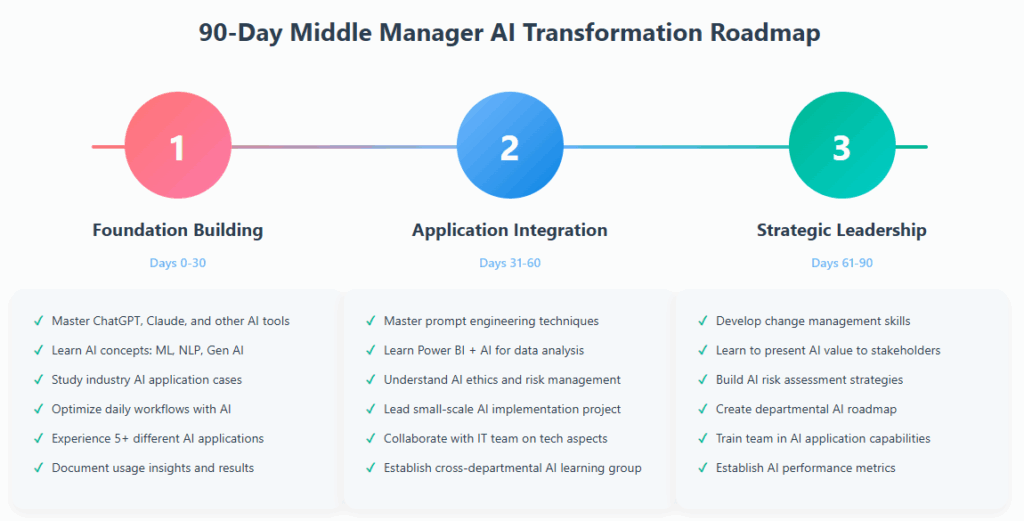
Phase 1 (Days 0-30): Building AI Foundation Literacy
Goal: From AI novice to beginner
Learning Tasks:
- Master basic operations of mainstream AI tools like ChatGPT and Claude
- Understand basic concepts like generative AI, machine learning, and natural language processing
- Read industry AI application cases to build application thinking
Practice Projects:
- Use AI tools to optimize daily workflows (meeting notes, email processing)
- Experience at least 5 different types of AI applications
- Record AI usage insights and effectiveness evaluations
Phase 2 (Days 31-60): Practical Application Integration
Goal: From beginner to application expert
Skill Development:
- Learn prompt engineering techniques
- Master data analysis and visualization tools (like Power BI + AI)
- Understand AI ethics and risk management principles
Project Participation:
- Lead a small-scale AI implementation project
- Collaborate with IT team to understand technical implementation processes
- Establish cross-departmental AI learning groups
Phase 3 (Days 61-90): Strategic Leadership Transformation
Goal: From application expert to change leader
Leadership Enhancement:
- Develop change management and communication skills
- Learn how to demonstrate AI value to different stakeholders
- Build risk assessment and mitigation strategies for AI implementation
Organizational Impact:
- Develop departmental AI application roadmap
- Train team members’ AI application capabilities
- Establish performance evaluation metrics for AI applications
Organizational Collaboration: Building an AI Transformation Support Ecosystem
Establishing “Tripartite Alliances”
Successful AI transformation requires middle managers to establish close cooperation with three key groups:
Technical Alliance with IT Department
- Understand technical possibilities and limitations
- Participate in AI tool selection and deployment
- Build translation mechanisms between technical and business needs
Talent Alliance with HR Department
- Identify team skill gaps
- Design talent development plans for the AI era
- Establish new performance evaluation systems
Strategic Alliance with Senior Management
- Obtain resources and authorization needed for transformation
- Ensure AI applications align with business objectives
- Build transformation vision and culture

Part IV: Specific Tools and Methodologies
Recommended AI Tool Portfolio
Core Productivity Tools
Meeting and Communication Management
- Microsoft 365 Copilot: Meeting notes, email processing, document collaboration
- Zoom AI Companion: Meeting summaries, action item tracking
- Notion AI: Knowledge management and team collaboration
Project and Task Management
- Motion: AI-driven scheduling and task prioritization
- Asana Intelligence: Project progress prediction and resource optimization
- Monday.com AI: Workflow automation and bottleneck identification
Data Analysis and Decision Support
- Power BI + AI: Business intelligence and predictive analytics
- Tableau AI: Automated data visualization
- IBM Watson: Enterprise-level AI analytics platform
Selection Criteria and Implementation Strategy
When choosing AI tools, middle managers should consider:
- Usability: Does the learning curve match team capabilities?
- Integration: Can it integrate well with existing systems?
- Scalability: Can it expand as needs grow?
- Cost-effectiveness: Is the return on investment reasonable?

Part V: Success Stories and Best Practices
Global Leading Enterprise Transformation Cases
Case Study 1: Microsoft’s Internal Transformation
Microsoft itself is the best example of AI transformation. The company’s middle managers successfully transformed through:
- Role Redefinition: From process managers to innovation drivers
- Rapid Skill Enhancement: Company-wide participation in AI literacy training programs
- Cultural Depth Change: Building an “AI First” mindset
Key Success Factors:
- Full support from senior management
- Comprehensive learning resources and training systems
- Culture that encourages experimentation and tolerates failure
Case Study 2: Western Enterprise Practices
According to McKinsey’s 2025 research, 92% of executives expect to boost AI spending in the next three years, with 55% expecting investments to increase by at least 10% from current levels. However, more than 80% of companies still report no material contribution to earnings from their generative AI initiatives.
- Strategic Integration: Combining AI with core business strategies
- Change Management: Systematic approach to organizational transformation
- Human-Centric Approach: Maintaining focus on employee development and well-being
Lessons from Failure Cases
Zillow’s AI Property Valuation Failure
Zillow’s attempt to use AI-generated property valuations for their home-buying division resulted in significant losses. The company reported $304 million in inventory write-downs in Q3 2021, with total losses exceeding $500 million from home purchases made in Q3 and Q4, leading to a 25% workforce reduction.
Key Lessons:
- AI applications require thorough testing and validation
- Cannot blindly rely on AI prediction results
- Need to establish human oversight and intervention mechanisms

Part VI: 2025-2030 Outlook
Technology Development Trend Predictions
The Coming of the AI Agent Era
According to research predictions, by 2025, AI agents will have higher autonomy to execute more tasks.
- Autonomous Decision-making: 15% of decision work will be executed by AI agents
- Multimodal Interaction: Comprehensive communication integrating text, voice, and visual
- Personalized Service: Deep learning of user preferences and work patterns
Impact on Middle Management:
- Need to learn to “manage” AI agents
- Redefine boundaries of human-machine collaboration
- Develop AI agent supervision and guidance capabilities
New Career Development Paths
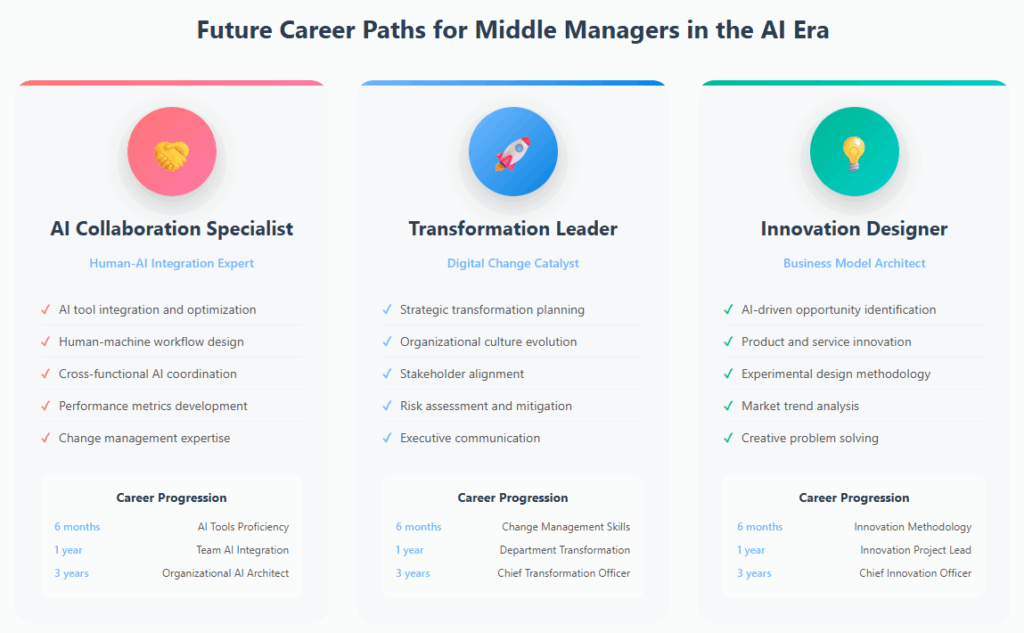
Three Future Career Paths
AI Collaboration Specialist Path
- Specialize in human-machine collaboration optimization
- Develop AI tool integration and application capabilities
- Become the organization’s “AI translator”
Change Leader Path
- Focus on organizational transformation and culture building
- Develop change management and leadership skills
- Become the “change catalyst” of the AI era
Innovation Designer Path
- Use AI insights to design new business models
- Develop innovative thinking and experimental design capabilities
- Become the “architect” of business innovation

Part VII: Action Guide
Week 1: Assessment and Planning
- Complete personal AI literacy self-assessment
- Research industry AI application trends
- Develop personal transformation goals and plans
Week 2: Tools and Skills
- Learn to use 3 AI tools
- Attend online AI training courses
- Discuss technical possibilities with IT colleagues
Week 3: Practice and Application
- Apply AI tools in daily work
- Collect team feedback and needs regarding AI
- Design a small AI application project
Week 4: Integration and Sharing
- Share AI application experiences with team
- Develop team AI implementation plan
- Report transformation progress and needs to superiors
Long-term Development Checklist
6-Month Milestones
- Successfully lead at least 2 AI application projects
- Establish cross-departmental AI collaboration network
- Significantly improve team AI application capabilities
- Become the AI change driver within the department
1-Year Goals
- Develop and execute departmental AI transformation strategy
- Cultivate at least 5 AI application seed talents
- Establish AI application effectiveness evaluation system
- Share best practice experiences within the organization
3-Year Vision
- Become an organization-level AI transformation leader
- Build replicable AI application models
- Influence industry AI application standard setting
- Cultivate next-generation AI-native management talent

Conclusion: Embrace Change, Lead the Future
In this era where AI reshapes work patterns, middle management faces not the question of “whether to change,” but the challenge of “how to change better.” Change never waits for those ready, but rewards those who dare to act.
Recent research emphasizes that successful AI transformation depends on whether middle management can become the bridge and driver of organizational AI transformation. The future belongs to those who can successfully integrate human wisdom with artificial intelligence. In this great transformation, middle managers are not eliminated, but the leaders who shape the future of work.