Have you noticed that when you Google something lately, the answer just appears right there?
No need to click on any website—AI organizes the answer and puts it at the top. For those of us who rely on ad clicks to make a living, this is a thunderbolt! According to the latest data from March 2025, AI Overviews’ trigger rate has reached 13.14%, more than double the 6.49% in January.
Even more shocking: nearly 60% of Google searches now end with “zero clicks.” That’s right, more than half of searchers leave after reading AI’s answer without clicking through to your website!

Don’t Panic! First, Here’s a Brutal but True Story
Remember 10 years ago? Back then, Google looked at your website twice and brought you one visitor. But now? It takes 18 views to get one person to click through. Even more extreme: OpenAI (ChatGPT’s parent company) has a ratio of 1,500 to 1, and Anthropic (Claude’s parent company) has an astonishing 60,000 to 1!
In 2024, global news websites’ organic traffic dropped from 2.3 billion to less than 1.7 billion visits—600 million clicks evaporated in one year. Some small websites saw their traffic cut in half, and some even lost 90% of their readers.
Sounds scary, right? But don’t rush to shut down your website, because SEO isn’t dead—it just got smarter!

Why Is Google “Shooting Itself in the Foot”?
You might wonder: Doesn’t Google make money from ads? In 2024, search brought Google $198 billion in revenue, accounting for over 50% of Alphabet’s total revenue. Why launch AI Overviews and reduce opportunities for people to click on ads?
The answer is simple: Google has no choice!
Imagine if you were still selling DVDs while everyone was watching Netflix—what would you do? When AI search tools like ChatGPT and Perplexity started stealing users, Google had to keep up or risk becoming the next Yahoo.
Back in 2021, someone at Google proposed adding chatbot functionality, but it was shelved due to concerns about advertising revenue. It wasn’t until ChatGPT burst onto the scene that Google realized it had to change.

Which Industries Are Hit Hardest? (Is Yours on the List?)
Based on our observations and data analysis, these three types of websites are disaster zones:
1. News Media Websites 📰
AI massively scrapes news content but doesn’t return traffic to media outlets. International news publishers have already united to protest Google’s “theft.”
2. Knowledge-Based Content Sites 📚
Sites providing “standard answers” are hit hardest, such as:
- Supplement ingredient guides
- Fitness equipment tutorials
- Legal document explanations
- DIY assembly instructions
Users see the answer in AI Overviews and leave—who’s going to click through to your site?
3. Comparison & Review E-commerce Content 🛒
Unboxing posts, product comparisons, recommendation lists… These former traffic magnets are now integrated into search results pages by AI.

Good News: SEO Isn’t Dead, It Just “Evolved”!
Here’s your shot of confidence: According to June 2025 analysis, AI search currently accounts for less than 1% of most websites’ traffic, with many sites even below 0.5%. Moreover, SEO still drives over half of website traffic.
More importantly, SEO’s definition has evolved from Search Engine Optimization to Search Everywhere Optimization.
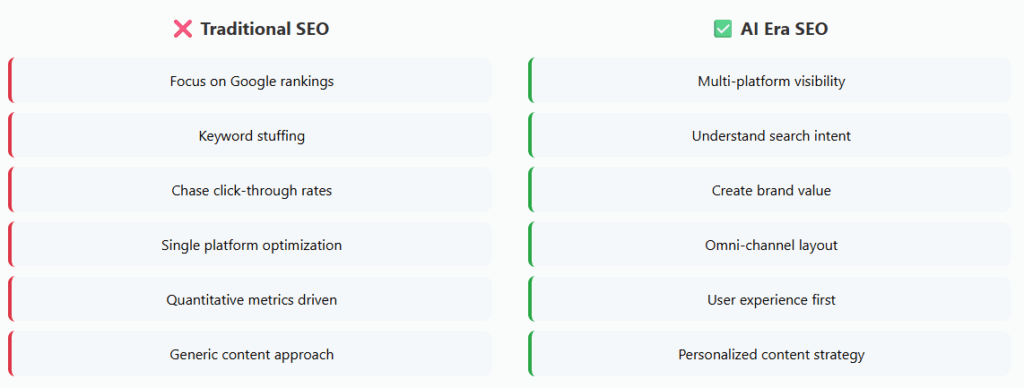
What does this mean? Simply put, you used to just need to master Google, but now you need to master everywhere users might search: Google, YouTube, Instagram, TikTok, ChatGPT… everywhere is your battlefield!

3 Major Strategies to Make AI Love Your Content
Strategy 1: Stop “Keyword Grabbing,” Start “Understanding Intent” 🧠
Past vs. Present Search Behavior:
❌ Past: “running shoes” ✅ Now: “Can I run a marathon with flat feet? Which running shoes do you recommend?”
See the difference? Users now ask complete questions instead of throwing out keywords. AI search engines use Natural Language Processing (NLP) to understand the real intent behind searches.
Practical Tips:
- Expand Your Keyword Territory
- Used to do 10 keywords? Now do 20+
- Focus on “long-tail keywords” (longer, more specific search terms)
- Remember: 88.1% of queries triggering AI Overviews are informational
- Think in “Scenarios”
- Don’t just write “running shoe recommendations”
- Write “How to choose shoes for rainy day runs,” “Running shoe guide for first marathoners”
- Provide solutions for specific situations
- Predict Users’ “Next Question”
- When users ask A, think about what B, C, D they might also want to know
- Naturally answer these follow-up questions in your content
Strategy 2: Build “Omnipresent” Brand Influence 🌐
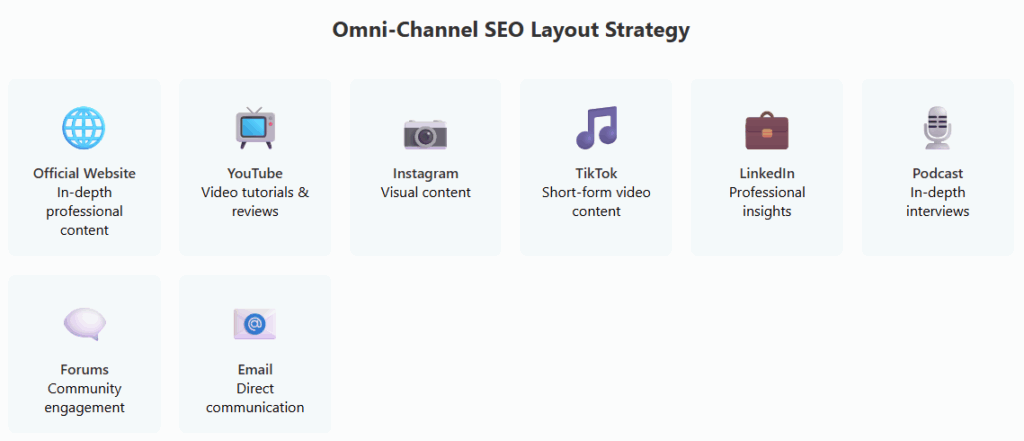
Remember when you could just optimize your website SEO and watch traffic roll in? Those days are gone! AI understands search content 360 degrees across the entire web.
Omni-channel Layout Map:
📍 Website: Deep professional content, complete product information 📍 YouTube: Unboxing reviews, tutorials, expert interviews 📍 Instagram/TikTok: Visual content, user testimonials, behind-the-scenes 📍 LinkedIn: Industry insights, professional sharing 📍 Podcast: In-depth discussions, expert conversations 📍 Forums/Communities: Answer questions, build authority
The Power of “Topic Clusters”:
Choose a topic you excel at, then go deep! For example, if you sell running gear, build this content structure:
🏃 Running Knowledge Center (Main Page)
   ├── 🏃 Complete Beginner's Guide
   ├── 🏃 Advanced Training Techniques
   ├── 🏃 Gear Selection Guide
   ├── 🏃 Injury Prevention & Recovery
   └── 🏃 Race Preparation Strategies
Each subtopic extends to 5-10 in-depth articles, connected with internal links. This way, both Google and AI will see you as a domain expert!
Strategy 3: “Speak” the Way AI Likes 🤖
AI prefers content that’s logically clear and well-structured, especially content that sounds like an expert explaining a problem.
AI’s Favorite Content Formats:
- Get Straight to the Point
- ❌ Wrong: Write a long background introduction
- ✅ Right: Answer the core question in the first paragraph
- Use Structured Elements
- Clear heading hierarchy (H1, H2, H3)
- Bullet points (like this)
- Concise comparison tables
- FAQ sections
- Add “Structured Data” Markup
- It’s like giving AI an “instruction manual”
- Tell AI what’s product info, what’s reviews, what’s pricing
- Use Schema.org standard formats
- Show Real Experience and Data
- Share first-hand experiences
- Provide original research data
- Cite authoritative sources

E-E-A-T: Content Quality Guide for the AI Era
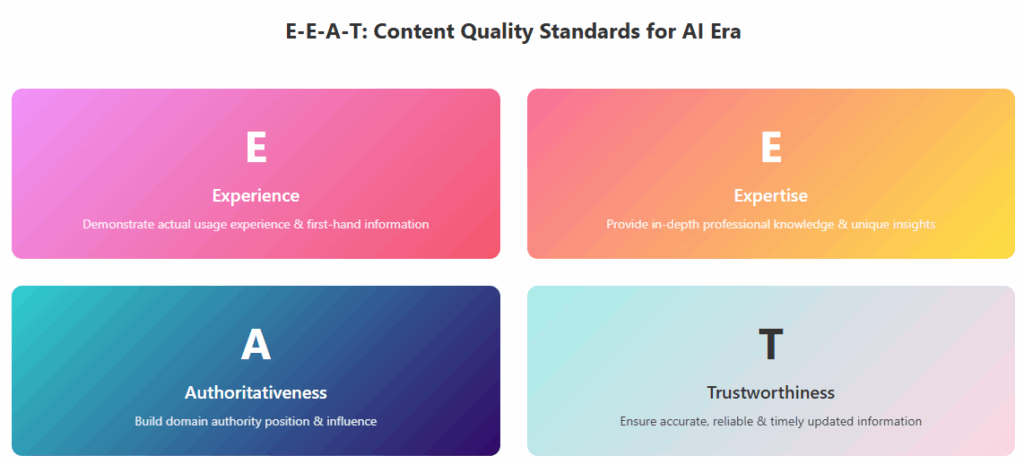
Google’s E-E-A-T principles have become even more important in the AI era:
E – Experience 👤
Show your actual experience. Don’t just say “this product is good,” say “I used it for 3 months and found…”
E – Expertise 🎓
Prove you really know your stuff. Cite research, show certifications, share professional insights.
A – Authoritativeness 👑
Become a thought leader. Get cited by other websites, earn media coverage, build social influence.
T – Trustworthiness 🛡️
Accurate information, reliable sources, timely updates. Wrong information will get you blacklisted by AI!

Recommended Tools: Let AI Be Your SEO Assistant
75% of marketers are already using AI tools to boost SEO efficiency. Here are the must-have tools:
Keyword Research 🔍
- Google Keyword Planner: Free basic tool
- Ahrefs/SEMrush: Professional competitive analysis
- Answer The Public: Find what users are really asking
Content Optimization ✍️
- ChatGPT/Claude: Help outline ideas, polish text
- Grammarly: Check grammar and readability
- Surfer SEO: Optimize content structure
Technical Optimization ⚙️
- Google Search Console: Monitor site health
- Google PageSpeed Insights: Test loading speed
- Screaming Frog: Site structure analysis
Data Analysis 📊
- Google Analytics 4: Track user behavior
- Microsoft Clarity: Heatmap analysis
- Similarweb: Competitor research

Don’t Just Look at Click-Through Rates! New Era Success Metrics
In the zero-click era, we need new KPIs:
1. Brand Visibility Metrics 👁️
- Times cited in AI Overviews
- Brand keyword search volume
- Social media mentions
2. Content Impact Metrics 💪
- Content share count
- Citations from other sites (backlinks)
- User dwell time and engagement depth
3. Business Value Metrics 💰
- High-intent keyword rankings
- Conversion rate over traffic
- Customer lifetime value

Take Action Now! Your 30-Day Plan
Days 1-10: Assess Current State 🔍
- Use GA4 to analyze which content still brings traffic
- Check if your content appears in AI Overviews
- Identify 3-5 topic areas to focus on
Days 11-20: Optimize Foundation 🛠️
- Rewrite popular articles in Q&A format
- Add structured data markup
- Optimize site loading speed (target < 3 seconds)
Days 21-30: Expand Territory 🚀
- Publish first YouTube tutorial video
- Create a 10-article topic cluster
- Start collecting user reviews and testimonials
2025 Second Half Trend Predictions
Based on latest data and industry observations, here are our predictions:
1. AI Overviews Will Become More Common 📈
With 72% growth from January to March, we expect trigger rates to reach 25-30% by year-end.
2. Voice and Visual Search Rising 🎤📷
“Hey Google, where’s the best ramen nearby?” These searches will increase.
3. Hyper-Personalized Search Results 🎯
AI will provide custom results based on your search history, location, and time.
4. Short Video SEO Becomes Essential 📹
TikTok SEO and YouTube Shorts optimization will be mandatory courses.
Conclusion: Don’t Fear Change, Embrace Opportunity!
Yes, AI search is changing the rules. But remember, every major shift eliminates some people and elevates others. The key is which side you choose.
SEO’s essence hasn’t changed—providing users with the most relevant, valuable information. AI just changed how information is delivered, but users’ need for quality content is eternal.
Instead of complaining about AI stealing your traffic, think about:
- How to create quality content that even AI wants to cite?
- How to build brand influence on every platform?
- How to truly solve users’ problems instead of just stuffing keywords?
One Final Tip: Don’t wait until traffic hits zero to start changing. Start now, optimize step by step, and let AI become your traffic booster, not terminator!
Is your website ready for the AI search era? Feel free to comment below with your experiences or challenges. Let’s find new growth opportunities together in this transformative time!
Sources and References
- Zero-click search data: Statcounter (2024), Manager’s Future Video Analysis
- AI Overviews growth data: Semrush AI Overviews Study (March 2025)
- Traffic decline data: Similarweb Global News Website Traffic Analysis (2024)
- Google revenue data: Alphabet Q3 2024 Earnings, Bloomberg Report
- E-E-A-T principles: Google Search Quality Evaluator Guidelines (2025)
- AI SEO statistics:
- SearchEngineJournal (2025)
- SEO.com AI SEO Statistics (2025)
- awoo 2025 SEO Trends Report
- Industry impact analysis:
- Manager Magazine Special Report
- Search Engine Land (June 2025)
- Lumar Blog: AI Search in 2025